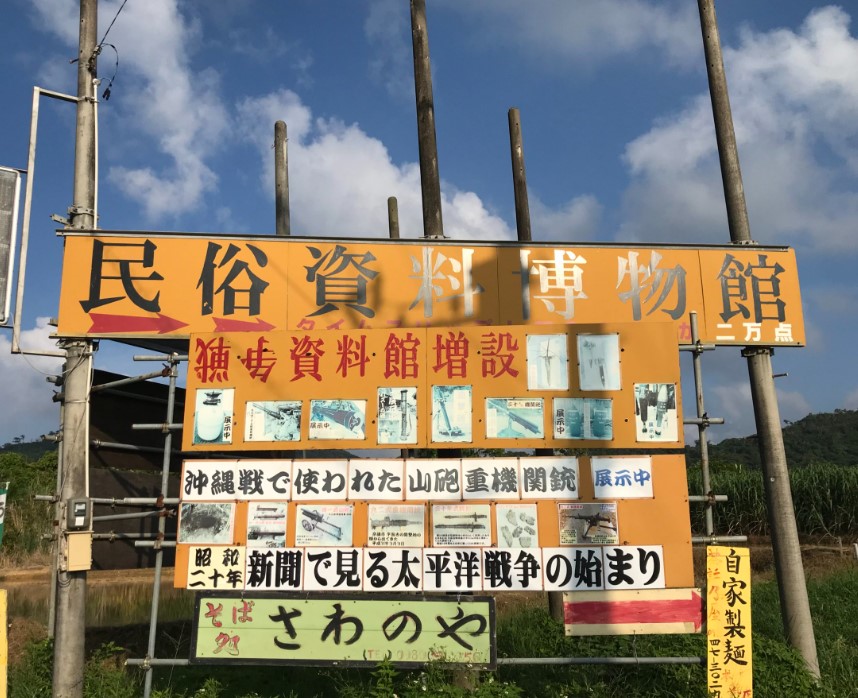
This is a private “Ethnographic Museum” located in Nago, northern Okinawa Island, about 1 hour and 12 minutes by car from Naha Airport. The museum has 20,000 items and materials collected by private individuals! Himeyuri and the Peace Memorial Park are nice, but this is the first place you should visit in Okinawa!
Point 1: What is the location of the “Museum of Folklore and Archaeology”?
The Folk Museum is located in Hanechi, Nago, in the northern part of Okinawa’s main island.
It is located about 6 minutes by car from the “Hanechi no Eki” Roadside Station, turning back toward Naha on National Route 58.
The exterior of the restaurant looks like a renovated private home, and the handwritten signboards give it a handmade feel. Once inside, you will find a lot of antique items lined up in a small space.
It is a bit daunting to think, “Are these things really from private collections? I felt a bit uncomfortable. The 85-year-old owner of the museum has been collecting these items by buying them at auctions or having acquaintances give them to him.
The purpose of opening the museum was to convey the past life of Okinawa, as well as the changing times such as the war and the reversion of Okinawa to Japan from the U.S., and to show the beauty of Okinawan handcrafts, which cannot be conveyed by industrial products, through crafts.
Point 2: What are the exhibits in the “Museum of Folklore and Archaeology”?
The “Museum of Folklore and Archaeology” exhibits about 20,000 items collected by the museum’s owner. The museum’s collection is said to be worth more than 100 million yen!
The exhibits include daily necessities, traffic signs, children’s playthings, and many other items that are nostalgic for the viewer and interesting for the younger generation. There are also agricultural implements, including a writing desk from the Ryukyu Dynasty era, which may be of cultural asset value.
A sanshin made of geraldine, which was made from scrap wood from airplanes and other objects during the war, is a valuable item! Nowadays, culture is neglected in many countries, but I can feel the enthusiasm for passing on culture even in times of scarcity.
In particular, there is a great deal of enthusiasm for war relics, and the collection seems to be richer than that of public museums.
Point 3: What is the “War Museum,” an annex to the “Folk Museum”?
The “Folk Museum” has an “annex” called the “War Museum” on the same site. The word “war” is upside down, which means “against war.
Inside, among the daily necessities of the time, Japanese military weapons such as red paper, sabers, a thousand man-needles, grenades, and land mines are on display. Even if you have heard of these, not many people have seen the “real thing”.
Also, the “dialect tags” in the photo are tags used for the punishment of “hanging a tag around your neck if you use a dialect”, which was strictly enforced in Okinawa in particular to promote the use of standard Japanese, although there used to be dialect restrictions in Kyushu, Tohoku, and other areas.
The tag was passed on to the next student who used a different dialect.
This may be due to the local characteristics of Okinawa.
The museum was opened before the war broke out, but now that Japan is about to be involved in the war on behalf of the U.S., the fact that the museum is exhibiting alternative daily necessities and actual weapons from a time when there were none available and widely open to the public is a great way to let the generation that does not know about the war know about the war. This is a very significant way to let the generation that does not know about the war know about the war.
The museum was opened because of the owner’s experience in Okinawa, a place that has suffered from the wounds of war in the past, and the Battle of Okinawa. I think it is a very good place and opportunity to think about the war as a “personal matter” in order to prevent Okinawa from becoming a battlefield again.